







Expedition: Saving Our Seas
Photos
Key Art
Episodic
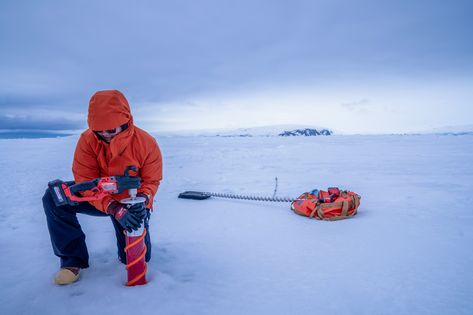
Allison Fong works with ice coring on a small sea ice island. Allison Fong’s Antarctic project aimed to measure the ecosystem functions of polar microbes from sea ice and seawater.Allison Fong’s Antarctic project aimed to measure the ecosystem functions of polar microbes from sea ice and seawater. Fong is a National Geographic Explorer, microbial oceanographer and polar ecologist specializing in the roles microbes play in biogeochemistry and marine ecology. Between December 12, 2024 and January 3, 2025, the Southern Ocean Expedition of Perpetual Planet, by National Geographic Society and Rolex took place. Aboard the Schmidt Ocean Institute ship Falkor (too), a group of more than 20 scientists and NGS Explorers explored the mysterious Antarctic waters and the species that live in them, from the Sea Ice, through the animals that inhabit them (penguins, seals, Skuas, seagulls, etc.) to the Antarctic benthos at more than 3800 meters deep. Photographer: Luján Agusti. Antarctica. 2024-2025.
Posted 10/08/26
ExpeditionSavingOurSeas_09.jpg
Download
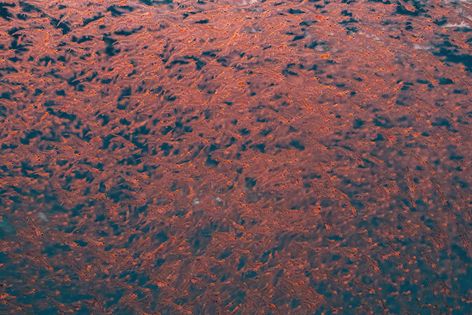
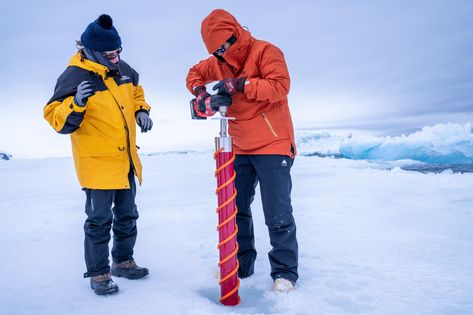
Scientist Allison Fong and team extracts an ice core on a small Antarctic sea ice floe.Allison Fong’s Antarctic project aimed to measure the ecosystem functions of polar microbes from sea ice and seawater. Fong is a National Geographic Explorer, microbial oceanographer and polar ecologist specializing in the roles microbes play in biogeochemistry and marine ecology. Between December 12, 2024 and January 3, 2025, the Southern Ocean Expedition of Perpetual Planet, by National Geographic Society and Rolex took place. Aboard the Schmidt Ocean Institute ship Falkor (too), a group of more than 20 scientists and NGS Explorers explored the mysterious Antarctic waters and the species that live in them, from the Sea Ice, through the animals that inhabit them (penguins, seals, Skuas, seagulls, etc.) to the Antarctic benthos at more than 3800 meters deep. (credit: Luján Agusti)
Posted 10/08/26
ExpeditionSavingOurSeas_08.jpg
Download
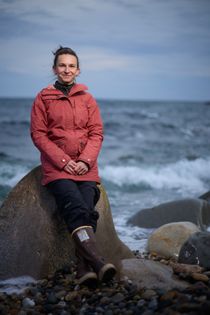
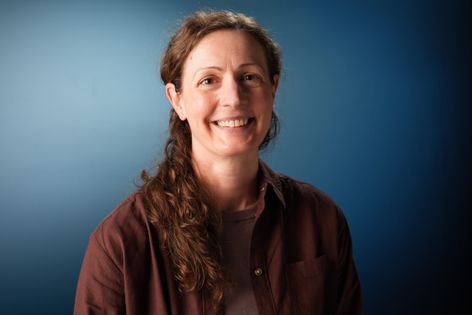
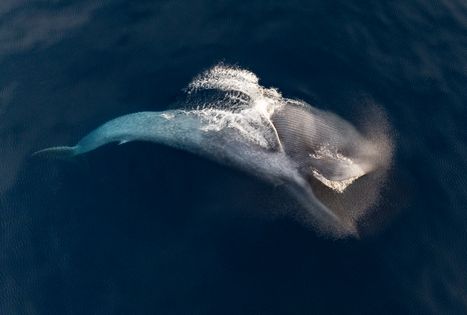
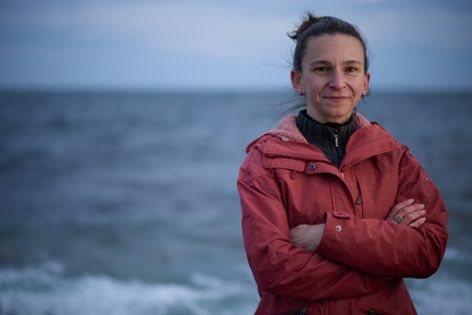

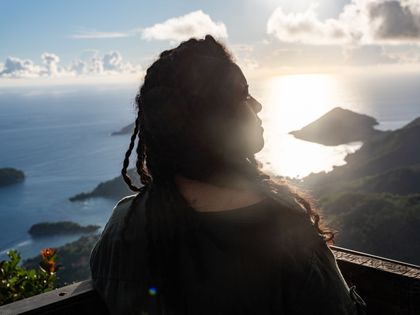
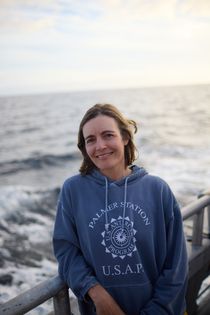
Marine biologist Sheena Talma hikes the trail to Morne Blanc, on the island of Mahé, Seychelles, on Wednesday, April 8, 2026, pausing to observe the endemic flora of the granitic peak's mist forest. Talma, a National Geographic Explorer and the first Seychellois scientist to receive a National Geographic Society research grant, leads deep-sea expeditions in the Indian Ocean, where more than 70 percent of Seychelles' marine territory lies beyond the reach of conventional research. The Seychelles archipelago—the only oceanic islands on Earth made of granite rather than coral or volcanic rock—holds an unusually intimate link between land and sea, with rainforested peaks like Morne Blanc feeding the freshwater systems and nutrient flows that shape the reefs and deep-sea habitats Talma studies offshore.
Posted 10/08/26
ExpeditionSavingOurSeas_03.jpg
Download
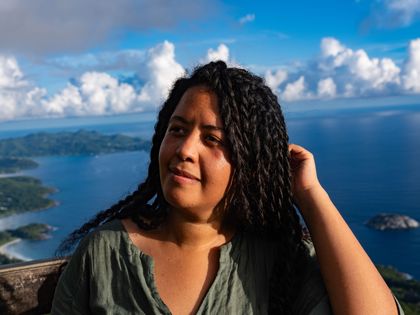
Marine biologist Sheena Talma hikes the trail to Morne Blanc, on the island of Mahé, Seychelles, on Wednesday, April 8, 2026, pausing to observe the endemic flora of the granitic peak's mist forest. Talma, a National Geographic Explorer and the first Seychellois scientist to receive a National Geographic Society research grant, leads deep-sea expeditions in the Indian Ocean, where more than 70 percent of Seychelles' marine territory lies beyond the reach of conventional research. The Seychelles archipelago—the only oceanic islands on Earth made of granite rather than coral or volcanic rock—holds an unusually intimate link between land and sea, with rainforested peaks like Morne Blanc feeding the freshwater systems and nutrient flows that shape the reefs and deep-sea habitats Talma studies offshore.
Posted 10/08/26
ExpeditionSavingOurSeas_02.jpg
Download

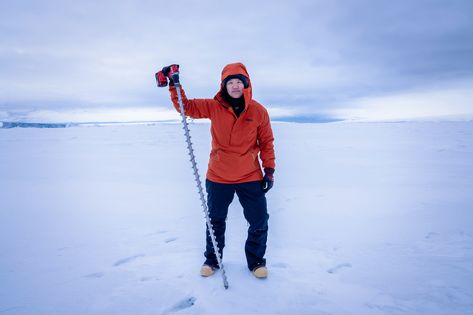
Allison Fong’s Antarctic project aimed to measure the ecosystem functions of polar microbes from sea ice and seawater. Fong is a National Geographic Explorer, microbial oceanographer and polar ecologist specializing in the roles microbes play in biogeochemistry and marine ecology. Between December 12, 2024 and January 3, 2025, the Southern Ocean Expedition of Perpetual Planet, by National Geographic Society and Rolex took place. Aboard the Schmidt Ocean Institute ship Falkor (too), a group of more than 20 scientists and NGS Explorers explored the mysterious Antarctic waters and the species that live in them, from the Sea Ice, through the animals that inhabit them (penguins, seals, Skuas, seagulls, etc.) to the Antarctic benthos at more than 3800 meters deep. (credit: Luján Agusti)
Posted 10/08/26
ExpeditionSavingOurSeas_14.jpg
Download
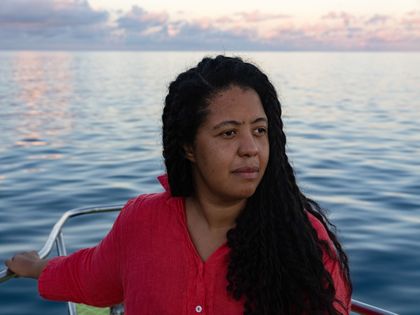
Marine biologist Sheena Talma travels by boat at dawn to Anse Diri, a remote cove on the southwestern coast of Mahé, Seychelles, on Thursday, April 9, 2026. Talma, a National Geographic Explorer and the first Seychellois scientist to receive a National Geographic Society research grant, leads deep-sea expeditions in the waters of Seychelles, where more than 70 percent of the country's marine territory lies in the deep sea. The Seychelles archipelago spans 115 islands across roughly 1.3 million square kilometers of the western Indian Ocean—a geography in which coves like Anse Diri, reachable only from the water, are part of the same ocean system Talma is working to map and protect from the surface down to 1,500 meters. (credit: Nichole Sobecki/National Geographic)
Posted 10/08/26
ExpeditionSavingOurSeas_01.jpg
Download
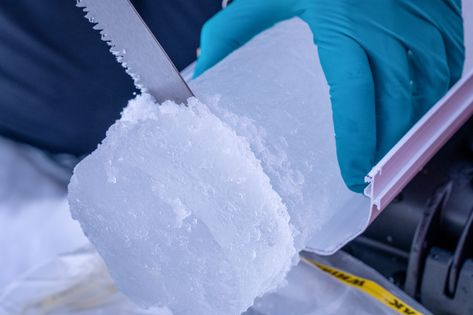
Detail of ice core cutting. Scientists Allison Fong and Adriana Lopes work cutting and measuring a piece of ice core on a small Antarctic sea ice floe.Allison Fong’s Antarctic project aimed to measure the ecosystem functions of polar microbes from sea ice and seawater. Fong is a National Geographic Explorer, microbial oceanographer and polar ecologist specializing in the roles microbes play in biogeochemistry and marine ecology. Between December 12, 2024 and January 3, 2025, the Southern Ocean Expedition of Perpetual Planet, by National Geographic Society and Rolex took place. Aboard the Schmidt Ocean Institute ship Falkor (too), a group of more than 20 scientists and NGS Explorers explored the mysterious Antarctic waters and the species that live in them, from the Sea Ice, through the animals that inhabit them (penguins, seals, Skuas, seagulls, etc.) to the Antarctic benthos at more than 3800 meters deep. (credit: Luján Agusti)
Posted 10/08/26
ExpeditionSavingOurSeas_05.jpg
Download
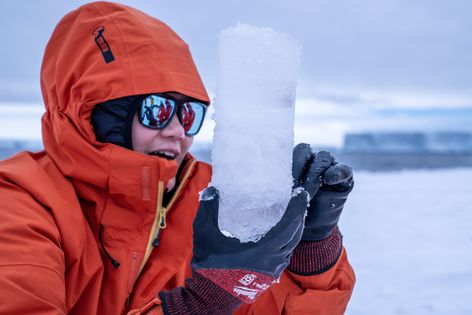
Scientist Allison Fong shows a small piece of ice core on a small Antarctic sea ice floe. Allison Fong’s Antarctic project aimed to measure the ecosystem functions of polar microbes from sea ice and seawater. Fong is a National Geographic Explorer, microbial oceanographer and polar ecologist specializing in the roles microbes play in biogeochemistry and marine ecology. Between December 12, 2024 and January 3, 2025, the Southern Ocean Expedition of Perpetual Planet, by National Geographic Society and Rolex took place. Aboard the Schmidt Ocean Institute ship Falkor (too), a group of more than 20 scientists and NGS Explorers explored the mysterious Antarctic waters and the species that live in them, from the Sea Ice, through the animals that inhabit them (penguins, seals, Skuas, seagulls, etc.) to the Antarctic benthos at more than 3800 meters deep. (credit: Luján Agusti)
Posted 10/08/26
ExpeditionSavingOurSeas_11.jpg
Download
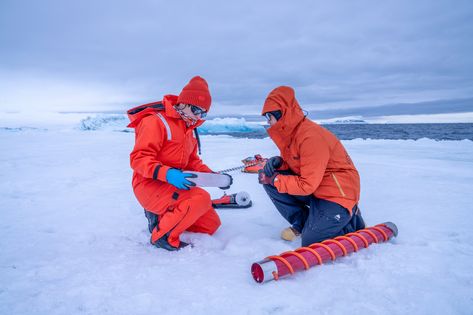
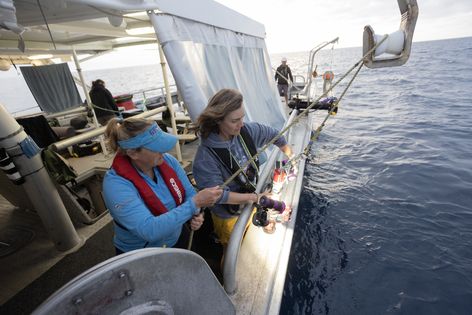
Scientist and team member Adriana Lopes (left) and Allison Fong (right) prepare for ice coring on a small sea ice island. Allison Fong’s Antarctic project aimed to measure the ecosystem functions of polar microbes from sea ice and seawater.Allison Fong’s Antarctic project aimed to measure the ecosystem functions of polar microbes from sea ice and seawater. Fong is a National Geographic Explorer, microbial oceanographer and polar ecologist specializing in the roles microbes play in biogeochemistry and marine ecology. Between December 12, 2024 and January 3, 2025, the Southern Ocean Expedition of Perpetual Planet, by National Geographic Society and Rolex took place. Aboard the Schmidt Ocean Institute ship Falkor (too), a group of more than 20 scientists and NGS Explorers explored the mysterious Antarctic waters and the species that live in them, from the Sea Ice, through the animals that inhabit them (penguins, seals, Skuas, seagulls, etc.) to the Antarctic benthos at more than 3800 meters deep. (credit: Luján Agusti)
Posted 10/08/26
ExpeditionSavingOurSeas_10.jpg
Download
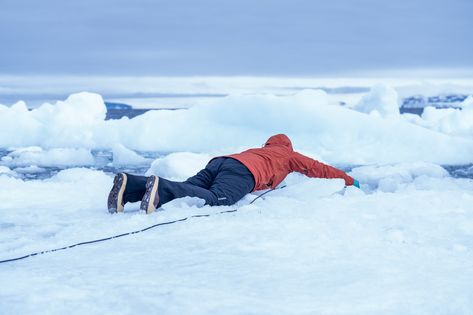
Scientist Allison Fong collects seawater samples and performs various measurements. Allison Fong’s Antarctic project aimed to measure the ecosystem functions of polar microbes from sea ice and seawater. Fong is a National Geographic Explorer, microbial oceanographer and polar ecologist specializing in the roles microbes play in biogeochemistry and marine ecology. Between December 12, 2024 and January 3, 2025, the Southern Ocean Expedition of Perpetual Planet, by National Geographic Society and Rolex took place. Aboard the Schmidt Ocean Institute ship Falkor (too), a group of more than 20 scientists and NGS Explorers explored the mysterious Antarctic waters and the species that live in them, from the Sea Ice, through the animals that inhabit them (penguins, seals, Skuas, seagulls, etc.) to the Antarctic benthos at more than 3800 meters deep. Photographer: Luján Agusti. Antarctica. 2024-2025.
Posted 10/08/26
ExpeditionSavingOurSeas_04.jpg
Download
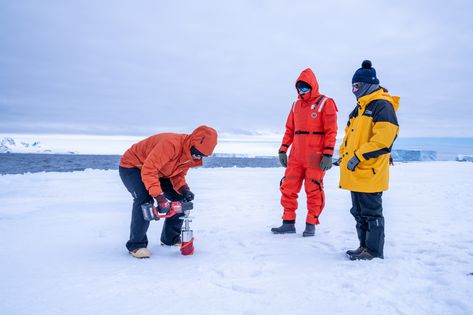
Scientist Allison Fong and team - Joao and Adriana Lopes - extracts an ice core on a small Antarctic sea ice floe.Allison Fong’s Antarctic project aimed to measure the ecosystem functions of polar microbes from sea ice and seawater. Fong is a National Geographic Explorer, microbial oceanographer and polar ecologist specializing in the roles microbes play in biogeochemistry and marine ecology. Between December 12, 2024 and January 3, 2025, the Southern Ocean Expedition of Perpetual Planet, by National Geographic Society and Rolex took place. Aboard the Schmidt Ocean Institute ship Falkor (too), a group of more than 20 scientists and NGS Explorers explored the mysterious Antarctic waters and the species that live in them, from the Sea Ice, through the animals that inhabit them (penguins, seals, Skuas, seagulls, etc.) to the Antarctic benthos at more than 3800 meters deep. Photographer: Luján Agusti. Antarctica. 2024-2025.
Posted 10/08/26
ExpeditionSavingOurSeas_12.jpg
Download
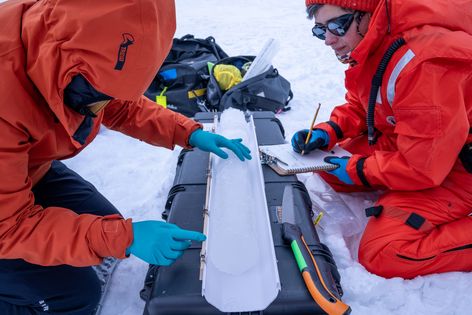
Scientists Allison Fong, left, and Adriana Lopes work cutting and measuring a piece of ice core on a small Antarctic sea ice floe.Allison Fong’s Antarctic project aimed to measure the ecosystem functions of polar microbes from sea ice and seawater. Fong is a National Geographic Explorer, microbial oceanographer and polar ecologist specializing in the roles microbes play in biogeochemistry and marine ecology. Between December 12, 2024 and January 3, 2025, the Southern Ocean Expedition of Perpetual Planet, by National Geographic Society and Rolex took place. Aboard the Schmidt Ocean Institute ship Falkor (too), a group of more than 20 scientists and NGS Explorers explored the mysterious Antarctic waters and the species that live in them, from the Sea Ice, through the animals that inhabit them (penguins, seals, Skuas, seagulls, etc.) to the Antarctic benthos at more than 3800 meters deep. (credit: Luján Agusti)
Posted 10/08/26
ExpeditionSavingOurSeas_06.jpg
Download
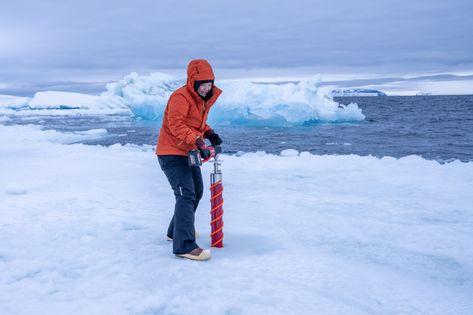
Scientist Allison Fong and team extracts an ice core on a small Antarctic sea ice floe.Allison Fong’s Antarctic project aimed to measure the ecosystem functions of polar microbes from sea ice and seawater. Fong is a National Geographic Explorer, microbial oceanographer and polar ecologist specializing in the roles microbes play in biogeochemistry and marine ecology. Between December 12, 2024 and January 3, 2025, the Southern Ocean Expedition of Perpetual Planet, by National Geographic Society and Rolex took place. Aboard the Schmidt Ocean Institute ship Falkor (too), a group of more than 20 scientists and NGS Explorers explored the mysterious Antarctic waters and the species that live in them, from the Sea Ice, through the animals that inhabit them (penguins, seals, Skuas, seagulls, etc.) to the Antarctic benthos at more than 3800 meters deep. (credit: Luján Agusti)
Posted 10/08/26
ExpeditionSavingOurSeas_07.jpg
Download
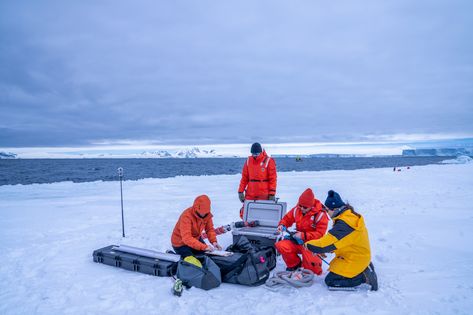
Allison Fong and a team of scientists prepare for ice coring on a small sea ice island. Allison Fong’s Antarctic project aimed to measure the ecosystem functions of polar microbes from sea ice and seawater. Fong is a National Geographic Explorer, microbial oceanographer and polar ecologist specializing in the roles microbes play in biogeochemistry and marine ecology. Between December 12, 2024 and January 3, 2025, the Southern Ocean Expedition of Perpetual Planet, by National Geographic Society and Rolex took place. Aboard the Schmidt Ocean Institute ship Falkor (too), a group of more than 20 scientists and NGS Explorers explored the mysterious Antarctic waters and the species that live in them, from the Sea Ice, through the animals that inhabit them (penguins, seals, Skuas, seagulls, etc.) to the Antarctic benthos at more than 3800 meters deep. Photographer: Luján Agusti. Antarctica. 2024-2025.
Posted 10/08/26
ExpeditionSavingOurSeas_13.jpg
Download